Coming soon: Kaeonix, and Kaeonix Avatar.
Kaeonix is our upcoming product: a browser chat, a terminal agent, and an API. Kaeonix Avatar is our model all three run on — a compact model trained end to end on software engineering, rather than a general chat model asked nicely to write code. That distinction is not marketing framing. It is the reason the product exists.
The problem with general-purpose models
Most coding tools today are the same arrangement: take a large general-purpose model, wrap it in a harness that can read files and run commands, and spend the system prompt teaching it to behave like an engineer.
It works. It is also expensive, and it is expensive in a way that compounds:
- The model has to be talked into engineering instincts every session, reach for the definition, read the test, check the diff; since none of that is native to it.
- Tool calling is a bolt-on. The model emits something that resembles a call, a wrapper parses it, and the result returns as more prose to re-read.
- Context is spent on the wrong things. A whole file arrives when three functions were needed, and the window fills before the task is finished.
- A wrong edit becomes a retry instead of a correction, because nothing closed the loop between the change and what the compiler said about it.
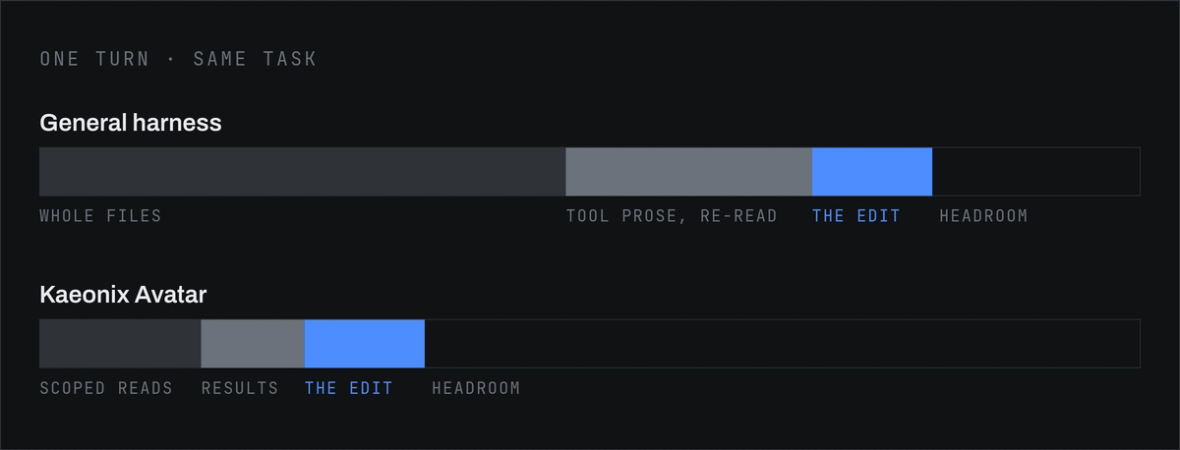
Each of those is a general model doing a specialised job. You pay for it twice — once in tokens, and again in the number of turns it takes to arrive anywhere.
What makes Kaeonix Avatar different
Built for code from the start
Engineering was the training objective, so the model's instincts are a developer's instincts: reach for the definition, read the test, check the diff. A general chat model has to be argued into that behaviour on every task. Avatar starts there.
Agent-native tool calling
Tools are part of the model's vocabulary rather than a wrapper around it. Avatar navigates a codebase, edits files, and runs commands in sequence, keeping track of what each call returned — and reading the result as a result, not as another wall of text to summarise.
Whole-repo context
A long window holds many files, long diffs, and pages of tool output in a single session, so the surrounding code stays in view while the change is being made. Reviewing a refactor across six files does not require re-establishing what those six files were.
Fast and lean by design
Purpose-built and compact means quick first tokens and a low cost per completed task. This is the coding model you can leave running — and the reason every plan ships with more included work than the price would suggest.
How a turn spends
Efficiency here is a design decision, not a side effect. Avatar reads what the task needs and leaves the rest on disk:
- Scoped reads — only the ranges the task needs, not whole-file dumps.
- Cached context — carried between turns instead of re-sent.
- Subagents — each with its own window and its own budget, keeping the main thread lean.
- Diagnostics — a bad edit is corrected against real compiler output rather than retried blind.
The practical effect is more turns before a compaction, and fewer turns wasted on work the model already did.
Where Kaeonix Avatar runs
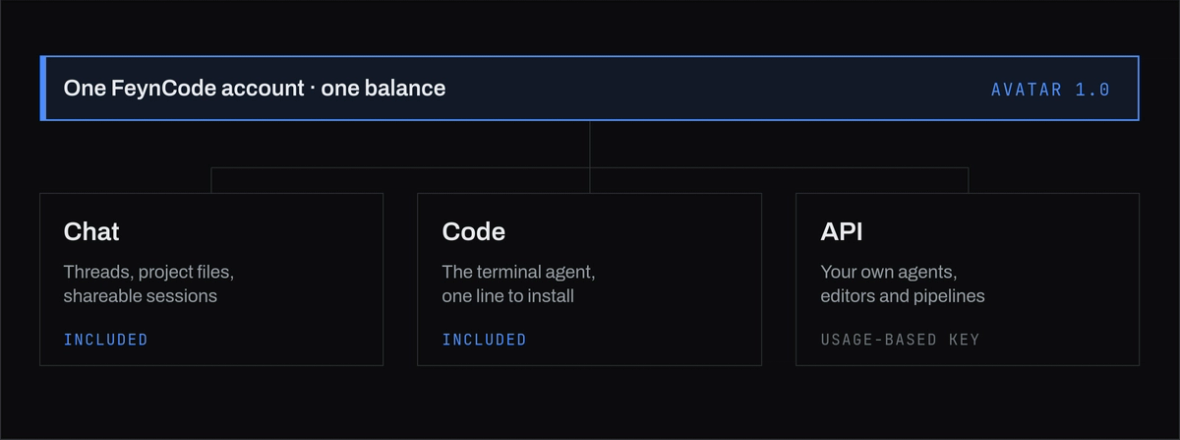
One account covers all three surfaces, drawing on the same balance:
- Kaeonix Chat — threads, project files, and shareable sessions in the browser. Included with every subscription.
- Kaeonix Code — the terminal agent, signed in with your FeynCode account. Included with every subscription.
- The Kaeonix API — usage-based, with a FeynCode-issued key. Drive your own agents, editors, and pipelines.
Why we built this
Because the honest version of the current market is that everyone is renting the same few general models and competing on the wrapper. That ceiling is real: you cannot prompt your way out of a model that was never trained to read a repository.
Training our own model for this one job is slower and harder than assembling another harness. It is also the only route to a coding agent that is genuinely cheap to run — and cost per completed task, not cost per token, is what decides whether you can leave an agent working on something.
What's coming at launch
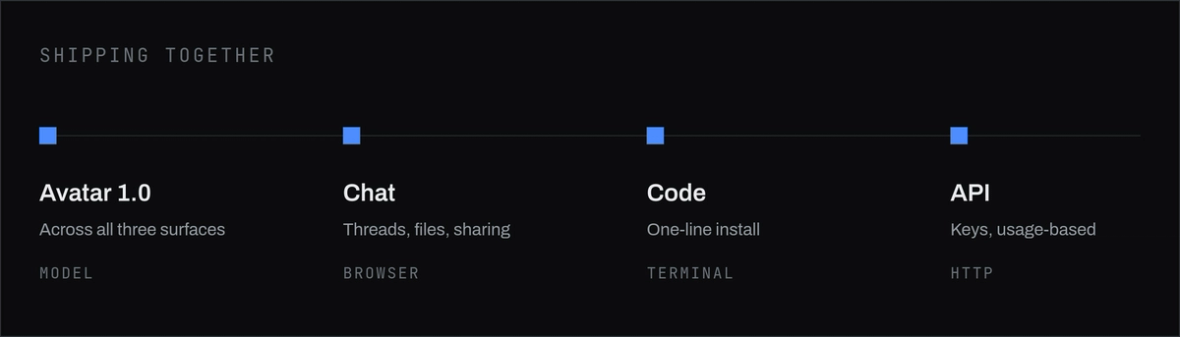
- Kaeonix Avatar 1.0, available across Chat, Code, and the API
- Kaeonix Chat, with threads, project files, shareable sessions and helpful tools
- Kaeonix Code, the terminal agent, installable in one line
- API access with FeynCode-issued keys and usage-based pricing
Join the waitlist
Kaeonix is pre-release. If you want early access and founding pricing, put your name down at kaeonix.com — we are looking forward to opening it in batches and stayed tuned for more updates as each surface goes live.
Kaeonix Avatar. A model trained on the work. One account, everywhere you do it.